Frida Kahlo Diego Rivera Studio House — San Ángel Guided Tour (2026)
Most visitors to Mexico City who want to follow Frida Kahlo's story go directly to Casa Azul in Coyoacán — and miss what is arguably the more revealing site entirely. The frida kahlo diego rivera studio house in San Ángel is where they worked, not where they lived. Two separate studios designed by architect Juan O'Gorman in 1931 and connected by a sky bridge — Diego's red and earth-tone studio large enough to house his pre-Hispanic collection, Frida's smaller blue-and-white studio built to her scale and her taste. This guided tour brings an expert to the site for 90 minutes, and the result is an understanding of their professional relationship and working lives that Casa Azul cannot provide. If you want to plan a full Frida and Diego itinerary, start with the museo frida kahlo tickets overview on the homepage.
About This Activity
Up to 24 hours in advance — full refund
Guided exploration of both studios and the sky bridge
San Ángel neighborhood, southwest Mexico City
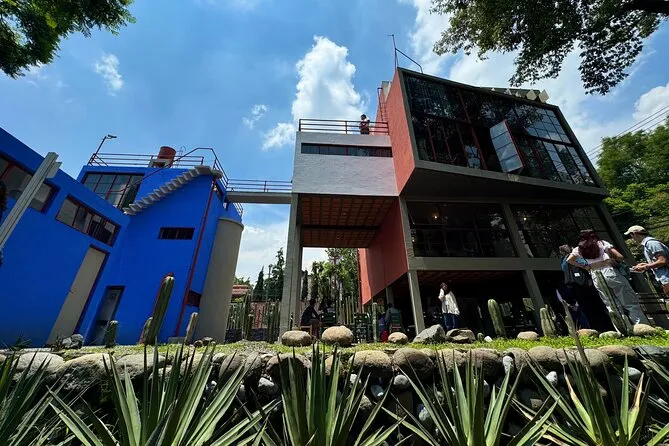
Frida's blue studio and Diego's red studio — connected by the famous sky bridge
Bilingual expert guide with background in Mexican modernist art history
Diego's extraordinary terracotta and ceramic collection fills the studio
Why the San Ángel Studio House Tells a Different Story from Casa Azul
Casa Azul is Frida's childhood home and the place she retreated to throughout her life — it is a home, and it feels like one. The San Ángel studio house is something different: a purpose-built working compound designed by one of Mexico's most important architects specifically for two productive artists. The distinction matters when you're trying to understand what Frida and Diego's daily life actually looked like in their working years.
In 1929, Diego Rivera was the most famous muralist in Mexico and one of the most famous artists in the world. He was 42 and had recently married Frida Kahlo, 21 years his junior. In 1931, he commissioned Juan O'Gorman to design two connected studios in the bohemian San Ángel neighborhood on the outskirts of Mexico City. The result is one of Mexico's most significant examples of functionalist architecture — and the physical expression of Frida and Diego's unusual working arrangement: close enough to collaborate, separate enough to maintain independent professional identities.
Juan O'Gorman and the Functionalist Design
Juan O'Gorman was 22 years old when Diego commissioned him to design the studios. He had just returned from studying Le Corbusier's principles in Europe and was in the early stages of what would become a landmark career in Mexican modernist architecture. The studios were among his first major commissions, and they show the functionalist doctrine in its purest form: the building exists to serve the work, not to impress.
The design placed Diego's large studio in the red building — with high ceilings, north-facing skylights, and floor space sufficient for the scale of his murals — and Frida's smaller blue-and-white studio adjacent, connected by a pedestrian sky bridge at the first-floor level. The two buildings share a wall but have completely different interior characters. Diego's is expansive, filled floor to ceiling with pre-Hispanic artifacts and the tools of a muralist. Frida's is contained, blue-painted, and arranged around a single working easel. The sky bridge above the cactus-lined garden path connecting them is the most photographed element of the site — a literal bridge between two very different artistic temperaments.
What You'll See — Both Studios in Detail
The guided tour covers both buildings fully across 90 minutes, with the guide contextualizing each space in terms of the artistic output produced there and the biographical events that unfolded during the years Frida and Diego worked here (roughly 1931–1940s).
- Diego's red studio — high-ceilinged, north-lit working space designed for murals; his drafting tables, brushes, and materials; the pre-Hispanic collection of terracotta, ceramic, and stone figures that filled every surface and shelf
- The sky bridge — the cactus-edged pedestrian bridge connecting the two buildings at first-floor level; the guide explains the architectural decision and what it expressed about the couple's relationship
- Frida's blue-and-white studio — smaller, more intimate scale; her easel, palette, and personal objects; the blue-and-white tiled walls she chose herself; windows designed to bring in natural light without direct sun
- The cactus garden below — O'Gorman designed the outdoor space with native Mexican cactus; Diego extended the pre-Hispanic theme into the landscaping
- The pre-Hispanic collection — Diego Rivera collected over 50,000 pre-Columbian artifacts across his lifetime; the studio houses a substantial portion of them, arranged with the enthusiasm of a collector who knew what he had
- The architectural exterior — the red building's rooftop crenellations and the blue building's distinctive color are visible from the street; the guide explains the color coding as both practical and symbolic
Diego Rivera's Pre-Hispanic Collection
Diego Rivera's passion for pre-Columbian art was not incidental — it was a core part of his political and artistic identity. He believed that the roots of Mexican modernism were in the indigenous civilization that pre-dated the Spanish conquest, and he spent decades acquiring terracotta figures, ceramic vessels, masks, and stone reliefs from Aztec, Teotihuacán, Oaxacan, and other Mesoamerican traditions.
The studio houses hundreds of these objects, arranged on shelves, tables, and in glass cases in a system that is more collection than display — the impression is of a working archive rather than a curated museum. Many of the figures are small domestic objects: women grinding corn, musicians, ball players, seated dignitaries. Seeing them in the studio where Diego actually worked alongside them — not in a sanitized museum setting — makes the collection feel immediate in a way that most pre-Columbian collections in major museums do not.
What's Included in the $49 Price
The $49 per-person price includes:
- Guided entry to Casa Estudio Diego Rivera y Frida Kahlo in San Ángel
- Expert bilingual English-speaking guide for 90 minutes
- Access to both studios — Diego's red building and Frida's blue-and-white building
- Sky bridge walkthrough between the two studios
- Guide's contextual narrative covering O'Gorman architecture, the pre-Hispanic collection, and the artistic relationship
Not included
- Transport to San Ángel — the studio house is at Calle Diego Rivera 2, San Ángel; approximately 20 minutes from Centro Histórico by Uber
- Optional Anahuacalli Museum (Diego's pyramid-shaped pre-Columbian museum nearby in Pedregal) — the guide can advise on visiting it as an extension
How the Guided Tour Flows
-
T−0
Meet at Casa Estudio San Ángel entrance
The guide meets the group at the entrance of Casa Estudio Diego Rivera y Frida Kahlo on Calle Diego Rivera 2. The guide introduces the site's history and the O'Gorman commission before entry.
-
+0:05
Juan O'Gorman architecture introduction
The guide covers the functionalist design principles from the exterior — the color logic (red for Diego, blue for Frida), the rooftop details, the scale contrast between the two buildings. The exterior view is one of the best in San Ángel.
-
+0:15
Diego's red studio — large building
Entry into Diego's working studio. The guide explains the north-facing skylights and their importance for mural preparation work, the scale of the room, and the pre-Hispanic collection — hundreds of terracotta and ceramic figures on every surface.
-
+0:45
The sky bridge
Walk the sky bridge connecting Diego's studio to Frida's. The guide discusses what this architectural element expressed about their working arrangement — connected, but separate. The view of the cactus garden below is a classic Casa Estudio image.
-
+0:55
Frida's blue-and-white studio
Entry into Frida's smaller studio. The contrast with Diego's space is immediate — contained, blue-painted, arranged around a single easel. The guide covers the objects, the light, and the specific years Frida worked here between operations.
-
+1:20
Discussion — their working relationship at San Ángel
The guide closes with context on the couple's professional relationship during their years at these studios: the periods of separation, Frida's increasing artistic reputation, and the divorce and remarriage in 1940. The studios tell this story physically in a way that Casa Azul does not.
-
+1:30
Optional: Anahuacalli Museum
The guide advises on visiting the Anahuacalli Museum, Diego's pyramid-shaped pre-Columbian museum in the Pedregal neighborhood a few kilometers away. It is the logical companion to the studio house visit for anyone focused on Diego's artistic universe.
Important Things to Know Before You Visit
San Ángel neighborhood
San Ángel is one of Mexico City's most beautiful colonial neighborhoods, with cobblestone streets, baroque churches, and a famous Saturday Bazar del Sábado artisan market on the central plaza. The studio house is at the eastern edge of the neighborhood's historic core, a 10-minute walk from the Plaza San Jacinto. Budget extra time before or after the tour to walk the area — the restaurants, galleries, and the Saturday market (if visiting on the right day) are among the best in the city.
What to bring
- Comfortable shoes — San Ángel has cobblestone streets and the studio's outdoor spaces have uneven surfaces
- Camera — the sky bridge, the exterior color contrast, and Diego's pre-Hispanic collection are all highly photogenic
- Notebook if you're artistically inclined — many visitors find the visit generative; the studios feel like working spaces
- Pesos for San Ángel's cafés and restaurants before or after the tour
Not allowed
- Touching Diego's pre-Hispanic collection — items are original and fragile despite appearing informally arranged
- Flash photography in certain rooms — the guide advises room by room
- Bringing food or drink into the studios themselves
Getting to Casa Estudio Diego Rivera y Frida Kahlo, San Ángel
Who This Tour Is (and Isn't) For
Ideal guests:
- Travelers who have already visited Casa Azul and want the full picture of Frida and Diego's world
- Architecture enthusiasts interested in Juan O'Gorman and Mexican functionalism — this is one of his early major works
- Art history visitors focused specifically on Diego Rivera's work and his pre-Hispanic collection
- Anyone who wants to understand the professional side of Frida and Diego's relationship, not just the biographical
Not suitable for
- Not suitable for: travelers expecting a visit to Casa Azul — this is a completely different site in a different neighborhood; the blue-walled childhood home is in Coyoacán
- What to bring: comfortable shoes for cobblestone streets, camera, small day bag; San Ángel's cafés are excellent for a post-tour coffee
- Not allowed: touching the pre-Hispanic collection, flash photography in designated rooms, bringing food into the studios
Frida Kahlo Diego Rivera Studio House — Frequently Asked Questions
Is the San Ángel studio house the same as Casa Azul?
No — they are completely different sites in different neighborhoods. Casa Azul (the Frida Kahlo Museum) is in Coyoacán and was Frida's childhood home and primary residence. The Casa Estudio in San Ángel was the purpose-built working studio complex designed by Juan O'Gorman in 1931, where Frida and Diego worked during their creative peak years. They are about 8 km apart. To visit both, allow separate half-days. For entry tickets to Casa Azul, see the skip-the-line casa azul tickets overview.
What is the sky bridge at the studio house?
The sky bridge is the first-floor pedestrian walkway connecting Diego Rivera's large red studio to Frida Kahlo's smaller blue studio. Juan O'Gorman designed it as a literal connection between two architecturally and artistically distinct buildings. It crosses above the cactus-planted garden path below. Visitors walk across it as part of the guided tour, and it is one of the most memorable moments of the visit — the contrast between the two studios on either side of the bridge is immediate and striking.
Do I need to visit Casa Azul first, or can I visit the studio house on its own?
The studio house stands completely on its own as a visit — it does not require prior knowledge of Casa Azul to be meaningful. That said, visiting Casa Azul first gives you the biographical context (Frida's accident, her recovery, her personal life in Coyoacán) that makes the studio house's focus on professional work even more resonant. If you have two days in Mexico City, consider Casa Azul on day one and the studio house on day two.
Who was Juan O'Gorman and why does it matter?
Juan O'Gorman (1905–1982) was one of Mexico's most important architects, a pioneer of functionalist design in Latin America and later famous for the mosaic-covered Central Library at UNAM. The San Ángel studios were among his earliest significant commissions, completed when he was 26 years old. They are studied in architecture schools as canonical examples of functionalism — buildings where every element serves a working purpose and nothing is decorative. Diego Rivera's commission made O'Gorman's early career. The studios are as important architecturally as they are biographically.
Is there anything to see in San Ángel beyond the studio house?
Yes — San Ángel is one of Mexico City's most rewarding neighborhoods for an afternoon walk. The Plaza San Jacinto hosts the Bazar del Sábado (Saturday artisan market) — one of the best craft markets in the city. The Museo del Carmen, a former Carmelite convent, is a five-minute walk. The streets between the studio house and the plaza are lined with colonial architecture, galleries, and some of Mexico City's finest restaurants. Most guests extend their visit by an hour or two after the guided tour ends.
How is this tour different from the expert tour at Casa Azul (tour-5)?
The two tours are at completely different sites. This tour (tour-3) is at Casa Estudio Diego Rivera y Frida Kahlo in San Ángel — the working studios. The expert tour (tour-5) is at Casa Azul in Coyoacán — the home and museum. They complement each other and are the ideal two-visit combination for anyone seriously interested in Frida and Diego's world.
Can I visit Anahuacalli Museum as part of this tour?
Anahuacalli is not included in the $49 tour price, but the guide will advise on visiting it after the studio house tour. It is located in the Pedregal neighborhood, a few kilometers from San Ángel, and is Diego's purpose-built museum for his pre-Columbian collection — a pyramid-shaped building designed by Diego himself in collaboration with Juan O'Gorman. Visiting it the same day as the studio house is the most thematically coherent Frida-and-Diego itinerary in Mexico City.
Is the guided tour available in languages other than English?
The tour is conducted in English. Spanish-language guides may be available on certain dates — confirm at booking. The museum's information placards are in Spanish with English translations.
What Guests Say
Isaac was the best tour guide! We could clearly see how knowledgeable Isaac was about Frida's history and her artistic gifts.
I had been to Casa Azul twice before and thought I knew Frida's story well. The studio house tour in San Ángel completely reframed it for me — seeing where she actually worked, the sky bridge, Diego's pre-Hispanic collection filling every shelf. A different experience entirely.
The O'Gorman architecture alone would justify the visit. The guide explained the functionalist design principles in a way that made the whole building feel like a statement — which it was. And then the pre-Hispanic collection in Diego's studio is extraordinary. One of the best tours I've taken in Mexico City.